

Our Beliefs Become the Space We Create
Our Beliefs Become the Space We Create
Tara Eddy, M.S., P.P.S, NCSP
Educational Psychologist
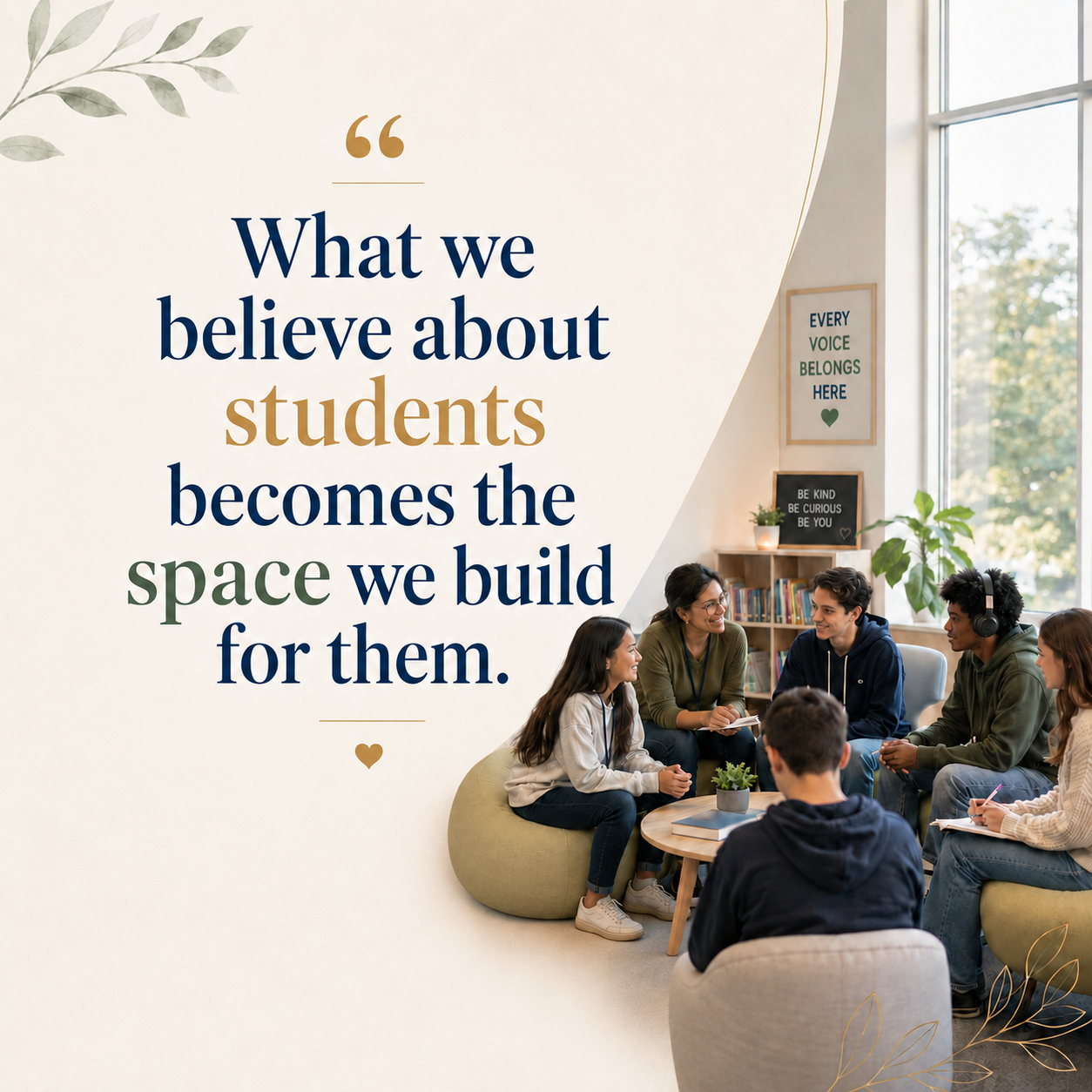
What we believe about children become the spaces that we create for them. These beliefs shapes our thinking, our emotional responses, and the action steps we take. Day in and day out, this becomes the environment we share.
Let me give an example.
Let’s say I have a student in my class who is not engaged in the task I’ve provided and they are quite loud with a peer next to them.
If my belief is that this student, who is disengaged and acting in a way that is disruptive to others, is purposefully disobeying what I have asked, my response to that child will be corrective and more punitive. Actions taken would move towards control.
If if is my belief that this student needs support to engage, and a classroom that has accessible pathways for this, my response to that child will be grounded in curiosity to find alignment with an engagement pathway.
Same student; same behavior, but the actions taken in that moment will result in very different outcomes.
A child who is refusing to write may be overwhelmed by language demands, working memory, fine motor fatigue, or fear of getting it wrong.
A child who won’t sit still may be showing us that their body needs movement in order to regulate their focus.
A child who isn’t listening may be missing the instruction because the room is loud, the language load is too high, or their brain needs more process time than what has been provided.
When my belief as an educator is that divergent brains are high valued, that divergent brains bring perspectives that others won’t have, and that our classroom goal is for everyone in that space to have multiple means of learning and sharing their knowledge, the whole equation changes.
This approach does not mean that adults and students don’t have hard moments, or that students are not responsible for their actions or learning. In fact, it’s the opposite. When multiple pathways for learning and sharing knowledge are always present, it actually becomes more of the students responsibility to align with the pathway that works for them and it creates a less chaotic environment for the adults.
We often personalize behavior in both directions. It’s a natural response, but it is often not helpful to our goals and to moving forward. I often hear statements like, “they just aren’t motivated” and “I’ve been teaching for 10 years. I should be able to manage this.” Statements like these indicate that we have some beliefs about ourselves and our students that we can unpack, so that the stories we tell ourselves help us to take meaningful action forward.
Most of the behavioral challenges we see in schools are often the visible result of a mismatch between a learner and an environment in any moment in time. This is ripe ground for curiosity about a better match. Barriers are often present in the environment, the systems, and relationships, not merely within a student.
The question we can ask is: What is the mismatch?
Have all of the options for sharing what they know been presented? Is more process time needed? Is the student unsure of how to begin or how to be successful? Are they well accustomed to the pathways and options available to them? Do they have the skills and regulation needed to move through this activity with the options provided?
When culture is strong, when beliefs have been reexamined, challenges that arise have a pathway. Teachers know what to notice and adjustment options are clearer. They have also set the stage for variability from the start. When we shift to curiosity, we do not become permissive. I say this to reassure teachers that this is not about allowing all behavior in our classrooms. This obviously isn’t possible or desirable for anyone. It is about becoming more aware of the mismatch in front of us and solutions to lessen the gap. It is so powerful when we can simultaneously reduce the shame adults feel about being caught in recurring behavior cycles and the frustration students experience when their needs and environment are mismatched. The outcomes can be extraordinary.
We are better able to see what is actually happening. We are better able to design learning spaces that fit a variety of needs. We are better able to do the work we came here to do. When we can do this, students are much more likely to experience school as a place where they are understood and safe to learn. In turn, the adults are much more likely to experience their workplace as one full of what they came into the field to do: to teach, to inspire, to create space for creativity and learning.
I believe schools should not have to wait until students are failing, refusing school, melting down, masking distress, or teachers are burned out before support becomes clear. Inclusive systems allow schools to set the stage before students even enter, to notice needs earlier, respond more skillfully, and create environments where learners can access school with dignity and belonging.
-Tara Eddy, Founder of Tara Eddy Global Consulting & CEO of Feelings in Motion.
For more information on the audit and framework to support international schools in this culture, inclusion and systems work, please connect me individually.